KEY HIGHLIGHTS
- National Council-JCM Drafting Committee held a two-hour meeting on 25 February regarding the 8th Pay Commission memorandum.
- Fitment factor (3.25 demand), minimum wage, allowances, pay structure and 18 key issues were discussed; final decision after next meeting post 10 March.
- Central employees and pensioners should track official updates closely as salary, pension and increment structure for the next decade may change.
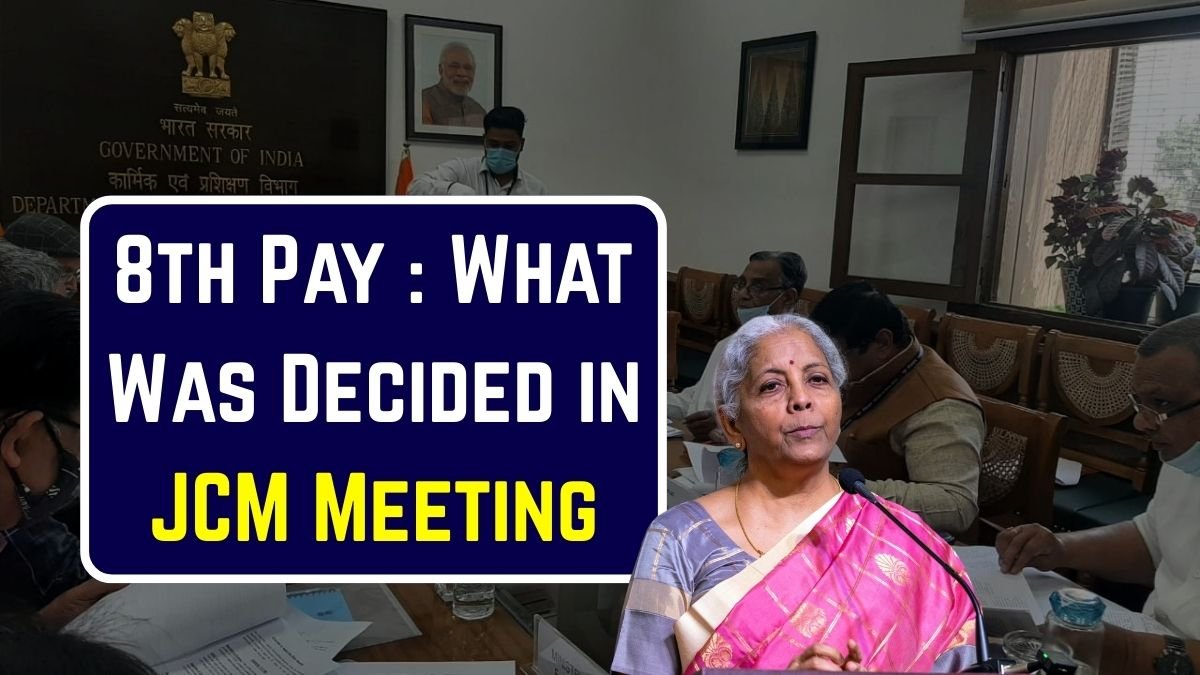
A crucial meeting of the National Council–JCM (Staff Side) Drafting Committee was held on 25 February to discuss key demands related to the 8th Pay Commission. The discussion lasted nearly two hours and focused on preparing a joint memorandum to be submitted to the government.
For over 50 lakh central government employees and 69 lakh pensioners, this meeting is significant as it could shape salary, pension and allowance structures for the next 10 years.
8th Pay Commission meeting update 2026
| Event/Category | Details/Dates |
|---|---|
| Organization Name | National Council – JCM (Staff Side) |
| Related Body | 8th Central Pay Commission (Proposed) |
| Meeting Date | 25 February 2026 |
| Next Meeting | After 10 March 2026 |
| Official Website | Available Here |
| Affected Beneficiaries | 50+ lakh employees, 69+ lakh pensioners |
What Issues Were Discussed?
According to staff-side leaders including Shiv Gopal Mishra (AIRF), the following major points were discussed:
1. Fitment Factor (Major Demand: 3.25)
The fitment factor determines the basic salary revision.
- Under the 7th Pay Commission, it was 2.57
- Employees are demanding 3.25
- If approved, this could significantly increase minimum basic pay
2. Minimum Wage Calculation
Discussion included:
- Revision of minimum wage formula
- Number of consumption units
- Impact of inflation and DA merger
This is critical because minimum pay affects all salary slabs upward.
3. New Pay Pattern
The committee discussed restructuring:

- Pay matrix format
- Grade pay rationalisation
- Annual increment structure
Employees are pushing for a 7% annual increment instead of the current 3%.
4. Allowances Review
Allowances such as:
- HRA
- TA
- Children Education Allowance
- Risk & hardship allowances
were discussed for revision and possible rationalisation.
5. Old Pension Scheme (OPS) Restoration
A strong demand remains for restoration of OPS for employees recruited under NPS. This issue is expected to remain central in upcoming discussions.
Representation Issue Raised by NPS Employees Federation
Dr. Manjit Singh Patel, National President of the All India NPS Employees Federation, raised a structural concern.
He highlighted that:
- Since 1961, employees of central autonomous bodies and Union Territories have not been properly represented in JCM.
- Many autonomous institutions function under central regulations but face delayed implementation of benefits.
- Demand: Grant formal representation to these employees in JCM.
This could impact lakhs of employees in autonomous institutions across ministries.

What Happens Next?
The drafting committee will:
- Finalise a joint memorandum
- Submit it to the 8th Pay Commission
- Hold another round of discussion after 10 March
Final acceptance of demands depends on:
- Government fiscal capacity
- Economic projections
- Commission’s internal recommendations
Why This Matters for Central Employees
If major demands like:
- Fitment factor 3.25
- 7% annual increment
- OPS restoration
are partially or fully accepted, salary revision could be substantial.
For example, if the current minimum basic pay of ₹18,000 is revised with a 3.25 factor, it could cross ₹26,000–₹27,000 (indicative calculation).
However, final figures will depend on official recommendations.
Who Will Be Affected?
Eligible Beneficiaries
- Central Government employees
- Defence civilian staff
- Railway employees
- Central autonomous body staff (if representation accepted)
- Pensioners and family pensioners
Selection / Implementation Process (How It Works)
Unlike recruitment, pay commission implementation follows this structure:

- Drafting committee prepares memorandum
- Submission to Pay Commission
- Commission evaluates demands
- Recommendations submitted to Government
- Cabinet approval
- Official notification and implementation
Implementation usually comes with arrears if applied retrospectively.
Editor’s Important Note
When the official notification is released, government portals may experience heavy traffic. Keep checking from trusted sources and verify circular numbers before forwarding salary calculations on social media. Many viral salary charts during 7th CPC were unofficial.
FAQs
1. When will the 8th Pay Commission be implemented?
There is no confirmed implementation date yet. Discussions are ongoing, and recommendations are expected after formal submission and evaluation.
2. What is the current demand for the fitment factor?
Employee unions are demanding a 3.25 fitment factor, higher than 2.57 under the 7th Pay Commission.
3. Will pensioners also benefit from the 8th Pay Commission?
Yes. Any revision in basic pay structure generally leads to revision in pension and family pension.
 Join
Join